

Electrical Bidding Software: What to Look For in 2026
Electrical bidding software is the part of your estimating system that turns a finished takeoff into a price you can submit and defend. It collects supplier and subcontractor quotes, applies labor rates and job conditions, calculates overhead, profit, and bond, prices alternates and unit prices, and produces the proposal. The best electrical bid software also tracks what happens next: who you bid to, what you bid, and which jobs you won.
In 2026, that last mile of the estimate carries more risk than it used to. Copper wire costs have climbed for three straight quarters, long-lead electrical gear is pushing project schedules out by a year or more, and the industry needs hundreds of thousands of new workers. A bid that was safe two years ago can lose money today if the quotes are stale, the labor is light, or the markup math is wrong.
This guide covers what to look for in electrical bidding software in 2026, feature by feature, along with the questions to ask before you choose a system.
Electrical Bidding Software
Take Your Next Bid From Takeoff to Proposal in One System
IntelliBid handles bid-day quotes, labor adjustments, overhead and profit, alternates, and proposals in Bid Recap. Bring a recent bid to a demo and see it on a job you know.
What Is Electrical Bidding Software?
Electrical bidding software is used to build, price, submit, and track bids for electrical construction work. It picks up where takeoff ends. Once quantities are counted and measured, the bidding side of the system answers the questions that decide whether you win the job and whether you make money on it:
- Which supplier and subcontractor quotes are you carrying, and are they current?
- How many labor hours does this job really need, at what rates?
- How much overhead, profit, and bond belongs on top, and is it calculated correctly?
- What do the alternates and unit prices come to?
- What goes in the proposal, and who receives it?
For most contractors, bidding software isn’t a separate product. It’s the bid stage of their electrical estimating software, working from the same database, takeoff, and labor units. That matters, because every time a number is re-keyed between programs, it’s a chance for an error to reach the final price.
It also helps to separate two kinds of tools that both get called electricians bidding software:
- Service quoting apps are built for residential and service work: a price book, a quick quote on a tablet, and a customer signature. They’re designed for speed on small jobs.
- Electrical contractor bidding software is built for plan-and-spec and design-build work bid to general contractors, owners, and construction managers. It has to handle takeoff from drawings, assemblies, labor factoring, quotes from multiple suppliers, alternates, bonds, and formal proposals.
If most of your revenue comes from bid work, the second category is the one to evaluate. The rest of this guide focuses on it.
Why Electrical Bidding Is Harder in 2026
Every bid is a promise to build for a fixed price at some point in the future. Right now, several cost drivers are moving faster than a typical bid’s validity period.
The 2026 Bidding Environment
- 16%Rise in Copper Wire Cost, Year Over Year
- 50%Section 232 Tariff on Many Copper Imports
- 349,000New Construction Workers Needed in 2026
- $84.1BData Center Starts, January to July 2026
Sources: Gordian RSMeans copper wire update, Oct. 13, 2026 (15.85% YoY); Section 232 copper proclamation effective April 6, 2026; ABC workforce forecast, Jan. 16, 2026; ConstructConnect Data Center Report, Aug. 28, 2026.
Here’s what those numbers mean on bid day:
- Material prices move between bid and award. Gordian’s RSMeans data shows copper electric wire up 15.85% year over year as of October 2026, the third straight quarter of at least 13% annual growth. Since April 6, 2026, Section 232 tariffs apply at 50% to many semi-finished copper products and 25% to other copper-intensive goods, based on full customs value.
- Long-lead equipment changes the schedule and the risk. Procurement data from mid-2026 puts 15kV medium voltage switchgear at 52 to 80 weeks and pad-mount transformers at 40 to 65 weeks, according to IndustrialSage. When gear arrives a year out, your quotes, labor rates, and escalation terms all have to hold up that long.
- Labor is scarce and expensive. Associated Builders and Contractors estimates the industry must attract about 349,000 net new workers in 2026, mostly to replace retirements, and notes that roughly one in five electricians is over 55. Overtime, shift work, and less experienced crews all show up in labor productivity.
- Big projects pull capacity. ConstructConnect reports $84.1 billion in data center starts through July 2026, nearly three times the same period last year. That work competes for the same electricians, gear, and supplier attention as everything else you bid.
None of this can be solved with software alone. But the right electrical bidding software makes it faster to re-price a bid when quotes change, easier to build real conditions into labor, and harder to submit a number that’s missing something.
1. Quote Management That Holds Up on Bid Day
The last few hours before a bid is due are mostly about quotes. Supplier pricing on gear and fixtures, subcontractor numbers for fire alarm or low voltage, and equipment rentals all arrive late and change often. Your bidding software should make it easy to:
- Keep quotes, equipment, and subcontracts separate, each assigned to the right phases
- See every quote for the job in one place and choose the best one for each scope
- Carry the same quote amount across the base bid and alternates without retyping it
- Update material pricing from live supplier sources, not last quarter’s price list
Live material pricing deserves its own question in a demo. With copper moving as much as it has, a system that pulls current supplier prices right before you finalize a bid protects your margin in a way that manual price updates can’t.
2. Labor Pricing That Reflects Real Job Conditions
Labor is the least predictable part of an electrical bid, and it’s where most money is lost. Material can be priced from quotes; labor depends on how the work actually goes in the field. Look for bidding software that adjusts labor for the conditions that change installation time:
- Labor units you can trust and adjust, with different difficulty levels for different kinds of jobs
- Automatic factoring for mounting height, floors above grade, and length of run
- Schedule adjustments for overtime, shift differentials, accelerated schedules, and the productivity loss that comes with them
- Weather adjustments for outdoor and unconditioned work
- Escalation for wage increases on multi-year jobs
- Multiple labor classes, each with its own regular, overtime, burden, and fringe rates, so union and prevailing wage jobs are priced correctly
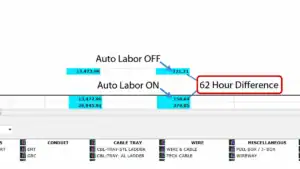
Automatic Labor Factoring in IntelliBid adjusts install time for job conditions.
A labor estimate should also tell you how much risk you’re taking on. Risk ratio, which is total profit divided by total labor dollars, shows how far labor can run over before the profit on a job is gone. Our article on adjusting for labor risk in your estimates walks through the math.
3. Overhead, Profit, and Bond Math You Can Trust
A surprising number of bids are lost, or won at the wrong price, because of how overhead and profit are calculated. The most common mistake is treating markup and margin as the same thing.
Markup Is Not Margin
10% markup = 9.1% margin A 10% markup on $100,000 of cost gives a $110,000 bid, but the $10,000 profit is only 9.1% of the price. A 10% margin gives a $111,111 bid, because profit is calculated as a share of the selling price, not the cost. On a $2 million job, the difference is about $22,000.
When you evaluate electrical bid software, check that it can:
- Calculate overhead and profit as either margin or markup, and make it obvious which one is in use
- Apply different percentages by job size, and different rates to labor, material, quotes, and subcontracts
- Calculate bonds with progressive rate levels, not a single flat percentage
- Capture direct job costs such as trailers, travel, per diem, tools, and permits
- Show cost per square foot, labor hours per square foot, and risk ratio as a sanity check before you submit
Before you change how your company applies overhead and profit, confirm the method with your financial leadership or accountant. The same percentage gives a different result depending on what it’s applied to.
IntelliBid Bid Recap
See Margin, Bond, and Risk Ratio on One Screen
Bid Recap brings quotes, labor, overhead, profit, bond, and job metrics together before you freeze the bid.
4. Alternates, Unit Prices, and What-If Bids
Very few bid packages ask for a single number. Owners and GCs want alternates, add and deduct unit prices, and sometimes different pricing for different bidders. Your bidding software should let you:
- Price alternates from the same takeoff by separating base and alternate work into phases, instead of building a new job for each option
- Calculate unit prices per receptacle, per fixture, or per foot of conduit, including the material, labor, and markup for the complete installation
- Run what-if scenarios on a copy of the bid, such as a different labor rate or crew mix, without disturbing the original
- Price the same estimate differently for different customers when your terms with one GC differ from another
5. Proposals That Go Out Complete and Consistent
The proposal is the only part of the bid your customer actually sees. Good bidding software generates it from the bid itself, so the price on the proposal always matches the price in the estimate. Look for:
- Reusable templates for openings, qualifications, exclusions, and closings
- A choice of how much pricing detail to show, from a single total to pricing by phase
- Alternates and unit prices included automatically when they apply
- Checks that catch items with no price or no labor before the bid is final
- A way to lock the bid you submitted, so later takeoff changes don’t alter the number you sent
- Email delivery with attachments, and a record of who received what
In 2026, your qualifications and exclusions are doing more work than usual. Many contractors now state how long material pricing is valid and how long-lead equipment and price escalation are handled. Templates make that language consistent on every proposal. Have your attorney review the wording.
Want proposals that pull pricing straight from the bid?
6. Bid Tracking and Win-Rate Reporting
If you don’t track results, you can’t tell whether you’re losing bids on price, scope, or customer fit. Electrical contractor bidding software should keep a record of every bid and its outcome:
- Bid due dates for every open job, so nothing gets missed
- Which contractors you bid to, what each received, and who won
- Competitor bid amounts, when you can get them
- Bids won, pending, and lost by estimator, customer, and type of work
- A way to compare a new bid against similar past jobs before you submit it
Over time, that history tells you where your win rate is strongest and which customers rarely award you work. It also makes it easier to spot a bid that looks light compared with similar jobs. For owners and managers, estimating analytics turns that data into dashboards for hit ratio, estimator workload, customers, and competitors.
The first quote I did was half a million, put together in 9 hours, and was successful by $2,000. IntelliBid left very little money on the table.
Brian OsmondOztech Electric
7. Change Orders After You Win
Winning the job is only the start. Changes in scope are where many electrical contractors recover margin or lose it. Bidding software that handles change orders the same way it handles bids lets you take off the change, apply the same labor and markup rules, send a change order proposal, and track its status until it’s approved. Keeping change orders tied to the original job also gives you a complete total for the base bid, alternates, and approved changes.
8. Pricing Sources, Integrations, and Data You Own
A bid is only as current as its prices and only as useful as where its data goes next. Ask how the system connects to:
- Supplier pricing services for current material costs, and whether you can compare prices across several local suppliers
- Your suppliers directly, for example by sending a cost request and importing their prices back into the bid
- Your accounting and job cost system, so a won bid becomes a budget without retyping
- Your takeoff tool, so quantities from electrical takeoff software flow into the bid without being re-entered
Also ask who owns your data, where it’s stored, and how you would get it out if you ever changed systems.
A Bid-Day Workflow in Electrical Bidding Software
Here’s how the pieces fit together on a typical bid:
- Complete the TakeoffCount and measure, with base and alternate work in separate phases.
- Price and QuoteUpdate material pricing and select supplier and subcontractor quotes.
- Adjust LaborApply crew rates, overtime, schedule, and job conditions.
- Finalize the PriceSet overhead, profit, and bond, then check risk ratio and cost per square foot.
- Submit and TrackLock the bid, send the proposal, and record the result.
Questions to Ask in an Electrical Bidding Software Demo
Bring a recent bid you know well, and ask the vendor to walk through it. These questions separate a real bidding workflow from a polished slide deck:
- How do I update material prices right before a bid is due, and where do the prices come from?
- Show me how a late subcontractor quote changes the base bid and every alternate.
- How do I add overtime, an accelerated schedule, or a second shift to the labor?
- Is overhead and profit calculated as margin or markup, and can I change it?
- How are bonds calculated on a large job?
- Show me how alternates and add and deduct unit prices appear on the proposal.
- What stops me from submitting a bid with unpriced items?
- How do I see my win rate by estimator and by customer?
- Which accounting and job cost systems can a won bid be exported to?
- What training and support come with the software, and who answers the phone?
For a broader checklist that covers the database, takeoff, and total cost of ownership, see our guide on how to choose electrical estimating software in 2026.
How IntelliBid Handles Electrical Bidding
IntelliBid brings the bid stage into the same system as your takeoff and database, so nothing is re-keyed between programs:
- Bid Recap. Quotes, equipment, subcontracts, direct labor, indirect labor, labor adjustments, direct job costs, and the final price in one place, driven by editable bid templates.
- Bid-day quotes. Quote Sheets show every quote for a job at once, and linked quotes keep quote amounts in sync across related bids.
- Live material pricing. Integrates with TRA-SER and ElectricSmarts NetPricer, which are licensed separately, plus supplier price files and cost request exports. Best Buy finds the lowest-priced supplier for each item.
- Labor tools. Six labor levels, Automatic Labor Factoring, the Labor Calculator for overtime, shift differential, accelerated schedules, and optimum crew suggestions, the Weather Calculator, labor escalation, and 10 labor classes with burden and fringe.
- Overhead, profit, and bond. Margin or markup, tiered rates by job size, progressive bond rates, and Job Info metrics including risk ratio and cost per square foot.
- Alternates and unit prices. Multiple bids per job, alternate bids by phase, and Breakouts for add and deduct unit pricing (included in Plus and Pro, an add-on for Standard). Bid Classes adjust the price for each bidding contractor.
- Proposals. Edit qualifications and exclusions, choose a pricing format, including pricing by phase, and submit by email from Journal/Messaging. Freezing a bid locks the number you submitted. Enhanced Proposals add rich formatting and images (included in Pro, an add-on for Standard and Plus).
- Bid tracking. Bid due dates, bidding contractors and results, job competitors, the Estimator Management report, and Bid Analysis against past frozen bids (included in Pro, an add-on for Standard and Plus). Conest Connect adds custom reports and dashboards.
- Change orders and exports. Change orders with their own bids, proposals, and status tracking (included in Pro, an add-on for Standard and Plus), and exports to accounting systems such as Sage 300 Construction and Real Estate, Trimble Spectrum, FOUNDATION, and Deltek ComputerEase.
Compare what’s included in each edition in the IntelliBid features comparison, or watch a quick introduction to IntelliBid below.
The Bottom Line: Bid Faster Without Guessing
Electrical bidding software won’t set your prices for you. What it should do is make every bid faster to assemble, easier to re-price when quotes change, and harder to submit with something missing. In a year when copper, gear, and labor are all moving, that’s the difference between a bid that wins the right work and one that wins the wrong work.
For more on building accurate bids, read The Art of Accurate Bidding: Tips for Electrical Estimators.
Electrical Bidding Software: Frequently Asked Questions
Electrical bidding software is used to build, price, submit, and track bids for electrical construction work. It takes quantities from takeoff and adds supplier and subcontractor quotes, labor rates and adjustments, overhead, profit, bond, alternates, and unit prices, then produces the proposal and records the result.
Electrical estimating software covers the whole process, from takeoff and assemblies to labor units and material pricing. Bidding is the final stage of that process, where quotes, labor adjustments, overhead, profit, and bond are applied and the proposal is created. In most systems, including IntelliBid, both stages work from the same job and database.
Look for quote management, live supplier pricing, labor adjustments for job conditions and schedule, overhead and profit calculated as margin or markup, bond calculations, alternates and unit pricing, proposal templates, checks for unpriced items, bid tracking with win-rate reporting, change orders, and exports to your accounting system.
No. Service quoting apps are built for fast, price-book quotes on residential and service calls. Bidding software for electrical contractors is built for plan-and-spec and design-build projects, where you need takeoff from drawings, assemblies, labor factoring, multiple supplier quotes, alternates, bonds, and formal proposals.
Update material pricing from current supplier sources as close to the bid deadline as possible, carry written supplier quotes for major gear, and state in your proposal how long pricing is valid and how escalation and long-lead equipment are handled. Have your attorney review that language.
Yes, if it records bid results. IntelliBid tracks bid due dates, the contractors you bid to, competitor amounts, and won, pending, and lost bids by estimator. Conest Connect adds custom reports and dashboards for hit ratio, estimator workload, customers, and competitors.
Yes. IntelliBid supports multiple bids per job, including alternate bids built from separate phases of the same takeoff. Breakouts calculate add and deduct unit prices, such as per receptacle, per fixture, or per foot, and are included in IntelliBid Plus and Pro and available as an add-on for Standard.
Ready to Build Your Next Bid in IntelliBid?
The fastest way to judge electrical bidding software is to see it on a job you’ve already bid.
See IntelliBid in Action
Bring a recent bid to a demo and walk through quotes, labor, markup, alternates, and the proposal on a job you know.
Compare IntelliBid Editions
See which bidding features are in Standard, Plus, and Pro, including Breakouts, Enhanced Proposals, and Bid Analysis.